

Valentin
May 2, 2026
The highest-performing festivals and events routinely sell 55-75% of their total ticket inventory before announcing a single performer. They do this because pre-lineup sales fundamentally change the economics and psychology of running an event. With 57% of buyers now waiting until the final week, pre-lineup sales are more valuable than ever.
Pre-lineup ticket revenue solves the chicken-and-egg problem (and it's one of the three profit levers every organiser should know) every organizer faces: you need cash to book talent. The wrong ticketing platform makes this worse by holding your payouts, but you traditionally need talent to sell tickets. Festivals that couldn't crack this are the ones going under in 2026. Events like Glastonbury, Coachella, and New Zealand's own Rhythm & Alps have proven that when the event brand is strong enough, the experience itself becomes the product. Not the headliner. The experience.
Selling early also compresses your financial risk window. Instead of waiting until 4-6 weeks before the event to know if you will break even, pre-lineup sales give you confirmed revenue 6-12 months out. That cash flow funds artist deposits, production advances, and marketing budgets. It transforms event planning from a high-stakes gamble into a structured, de-risked operation.
There is also a powerful psychological effect at play. When 50%+ of tickets are already sold before lineup day, the announcement itself becomes an amplifier rather than a starting gun. The remaining inventory sells faster because social proof is already established. Thousands of people committed before knowing the lineup, which signals to the broader market that this event is worth attending regardless.
This guide covers the complete playbook for selling 70% of your tickets before lineup day. It walks through every tactic: pricing architecture, community building, content sequencing, and the operational mechanics that make it all work on a platform like 7am.
Blind-bird pricing is the deepest-discount ticket tier, released before any event details are confirmed. No lineup, no specific dates, sometimes no venue. Buyers commit purely on trust in the event brand.
The term originated in the festival circuit and has become standard practice for recurring events worldwide. The mechanics are simple: within 24-72 hours of your current event ending (while attendees are still emotionally high from the experience), you release a limited allocation of next-year tickets at the lowest possible price, typically 40-60% below the eventual door price.
Blind-bird pricing works because of three converging forces:
1. Peak emotional state. The moment your event ends is when brand affinity is highest. Attendees have just lived the experience. They are surrounded by friends who shared it. Endorphins and nostalgia make this the single most persuasive sales moment of the year. Capturing that intent immediately, while people are still on-site or scrolling through their photo rolls, converts at rates no marketing campaign can replicate.
2. Loss aversion and scarcity. A blind-bird tier with a visible quantity cap (say, 200 tickets) and a 48-72 hour window activates loss aversion. People do not want to miss the cheapest price. When the counter shows "47 remaining," urgency compounds. This is not manufactured scarcity. It is real, and buyers understand the mechanics. They buy because the deal is genuine.
3. Social signalling. Buying a blind-bird ticket is a status signal within the event community. It says: "I am committed. I was there last year and I will be there next year." In community-driven events, that signal has real social currency. People share their purchase on Instagram Stories and in group chats, which creates organic peer-to-peer marketing at zero acquisition cost.
For a New Zealand festival running 2,000-capacity, allocating 200-300 blind-bird tickets (10-15% of inventory) at a 50% discount generates immediate revenue while seeding the social proof engine that powers every subsequent sales tier.
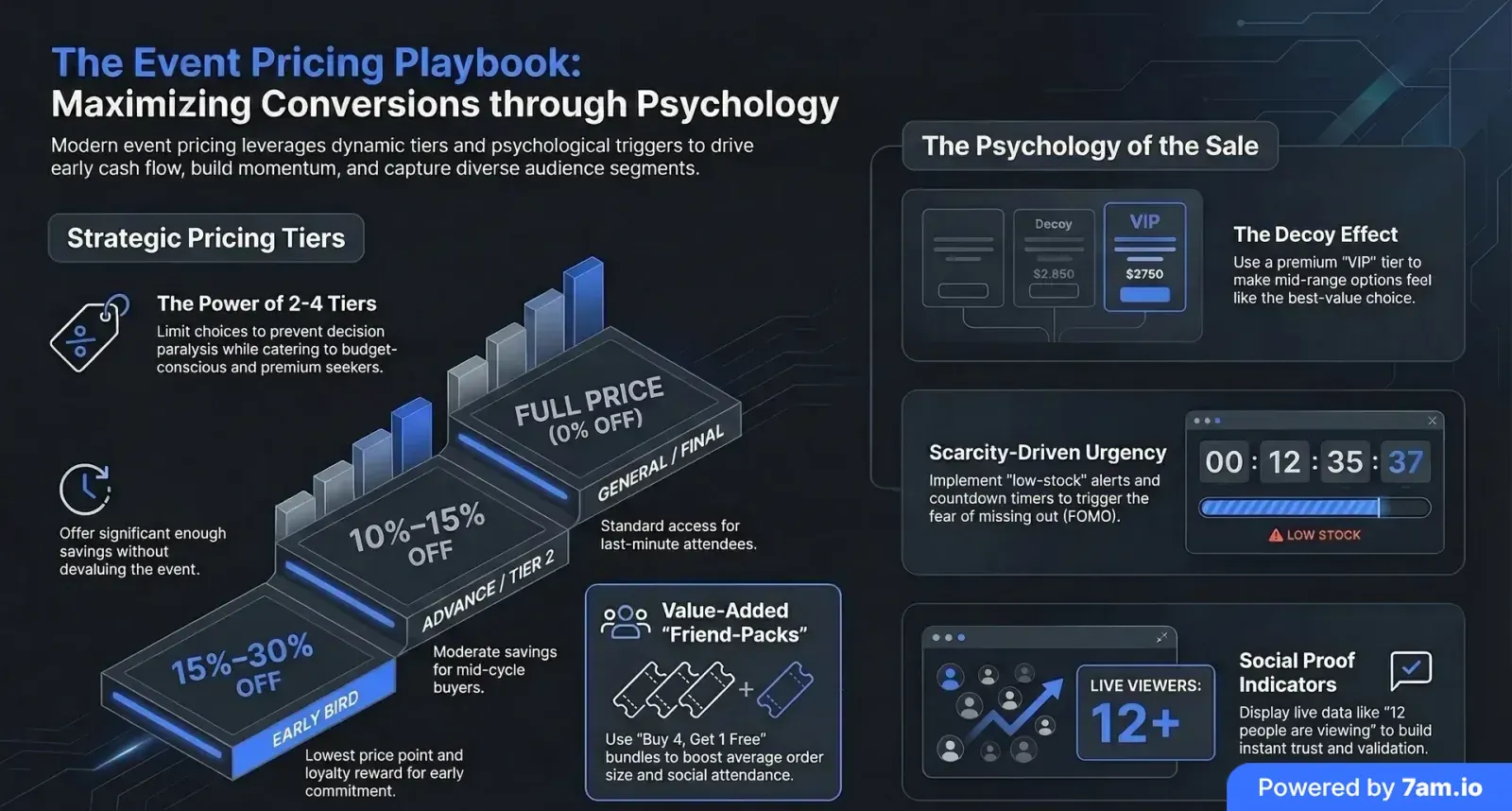
Use four to five pricing tiers, each with a quantity cap and time expiry, allocating 55-75% of total inventory across pre-lineup tiers. This tiered architecture creates sustained urgency across months rather than a single on-sale spike.
Here is a proven tier structure for a 3,000-capacity event with a $120 door price:
| Tier | Discount | Price | Allocation | Timing | Trigger |
|---|---|---|---|---|---|
| Blind Bird | 50% off | $60 | 300 (10%) | 24-72 hrs post-event | Time + quantity cap |
| Early Bird | 35% off | $78 | 750 (25%) | 4-6 months before | Quantity cap |
| Loyalty Presale | 25% off | $90 | 450 (15%) | 3-4 months before | Promo code + quantity cap |
| General Pre-Lineup | 15% off | $102 | 450 (15%) | 2-3 months before | Quantity cap or lineup day |
| General Admission | Full price | $120 | 1,050 (35%) | Post-lineup | Open until sold out |
The critical design principle is automatic escalation. When one tier sells out, the next tier activates immediately. No gap. No dead air. On 7am, you can configure this as automatic tier transitions. When blind-bird inventory hits zero, early-bird activates within seconds. This keeps the sales engine running continuously.
Each tier transition is also a marketing moment. "Blind bird SOLD OUT in 6 hours" is a headline that drives early-bird conversions. "Early bird 80% gone" is an email subject line that pulls fence-sitters off the fence. Every sell-out creates content that fuels the next tier.
Pricing the tiers. The gap between tiers matters more than most organizers realize. If blind bird is $60 and early bird is $62, there is no urgency to buy blind bird. Maintain 15-25% price jumps between tiers so each level feels meaningfully more expensive than the one before it. The buyer who missed blind bird should feel a real sting, enough to make them faster next time, but not enough to abandon their purchase entirely.
Shift the value proposition from "who is playing" to "what is the experience." Pre-lineup demand is built through brand storytelling, community identity, and progressive content reveals that make the event itself the reason people buy. Not the performers.
This is the strategic core of the entire playbook. It requires year-round effort, not a 6-week campaign.
Aftermovies are your highest-converting asset. A professionally produced 3-5 minute aftermovie released within 2 weeks of your event generates 3-5x more engagement than any other content type. It captures the emotions, the production quality, the crowd energy, the sense of belonging that define your event. Post it everywhere: Instagram Reels, TikTok, YouTube, Facebook, email. Pin it to the top of your social profiles. Every frame of that aftermovie is a sales argument for next year.
User-generated content (UGC) extends your reach. Encourage attendees to tag your event and use a branded hashtag. Repost the best UGC on your official channels. This does two things. It rewards your community with visibility. And it creates social proof from real attendees, which is more persuasive than any branded content. A real person posting "best weekend of my life at [Event]" does more for pre-lineup sales than a professional ad ever will.
Community platforms create a home between events. The most successful pre-lineup sellers maintain year-round communities on Discord, Facebook Groups, or WhatsApp. These are spaces where past attendees share memories, speculate about next year, form camping groups, and build friendships. When blind-bird tickets drop, these communities are the first to buy, often selling out tiers within hours.
The community itself becomes part of the product.
Progressive content reveals sustain interest. You do not need the lineup to create anticipation. Instead, reveal non-lineup details over time: the venue or location, the stage design, new areas or activations, food vendors, camping upgrades. Each reveal is a content piece, an email, and a social post. Spread them across 3-6 months to keep the event in people's feeds consistently.
Nostalgia triggers drive repeat purchases. On-This-Day posts, throwback photos from previous years, "remember when" stories, milestone celebrations (5th anniversary, 10,000th attendee). All of these activate nostalgia and remind past attendees why they love the event. Time them around tier launches for maximum conversion impact.
A loyalty presale gives previous attendees exclusive early access to tickets before the general public. It typically converts 25-40% of your previous year's audience into confirmed repeat buyers, making it one of the most reliable revenue streams in event ticketing.
The mechanics are straightforward. After your event, collect email addresses and order data from all attendees. Segment them into a "past attendees" list. When the loyalty presale tier opens (typically 3-4 months before the event), email this list with a unique promo code that unlocks the loyalty price, usually 20-30% off door price.
What makes loyalty presales powerful is the combination of exclusivity and recognition. Past attendees feel valued. They get access before everyone else, at a price the general public cannot access. This is not a discount. It is a relationship signal. And in community-driven events, that relationship is the entire business model.
How to maximize loyalty presale conversion:
Segment by engagement level. Someone who attended 3 of the last 4 years is a different buyer than a first-timer. Give multi-year attendees an even deeper discount or exclusive perks like early campsite selection, priority parking, or merch bundles.
Create urgency within the tier. Even loyalty tiers need quantity caps. "500 loyalty tickets available, your code expires in 72 hours" performs dramatically better than an open-ended offer.
Make it shareable but exclusive. Allow past attendees to share a referral link that gives their friends a smaller discount (say, 10% off) while giving the referrer a credit. This turns your loyalists into an active sales force.
Use the ticketing platform's built-in tools. On 7am, custom promo codes can be generated per segment, with quantity limits and expiry dates. The platform tracks redemption automatically, so you know exactly how your loyalty tier is performing in real time.
The data from loyalty presales is also strategically valuable. If 40% of last year's attendees buy loyalty tickets, you have a strong retention signal. If only 10% convert, something is wrong. Either the pricing, the event experience, or the communication needs attention. This data feeds directly into your planning for the next edition.
FOMO (fear of missing out) in ticket sales is driven by three visible signals: diminishing availability, social proof from peers, and price escalation over time. When all three are present, conversion rates increase by 25-45% compared to static pricing.
FOMO is often dismissed as a buzzword, but in ticket sales it is a measurable, engineerable force. The key is that FOMO must be real. Fake countdown timers, inflated "limited availability" claims, and artificial scarcity destroy trust. Genuine FOMO comes from transparent mechanics.
Visible inventory counts. Showing "127 of 300 blind-bird tickets remaining" on the purchase page is the single most effective urgency driver. As the number drops, conversion rate rises. This is not manipulation. It is accurate, real-time information that helps buyers make informed decisions. 7am displays live inventory levels on the ticket purchase page, which creates natural urgency without manufactured pressure.
Tier expiry countdowns. When a pricing tier has a hard deadline ("Early bird ends Friday at midnight"), buyers have a clear decision point. Combine this with email reminders at 72 hours, 24 hours, and 2 hours before expiry. Each reminder converts a new segment of buyers who need progressive urgency to act.
Social proof notifications. Showing recent purchase activity ("Sarah from Auckland just bought 2 tickets") signals momentum. When people see others buying, it validates their own interest. Some organizers share milestone numbers publicly: "1,000 tickets sold. 500 remain before lineup day."
Price anchoring against future tiers. Always show the next tier's price alongside the current one. "Buy now for $78, next tier is $102." The $24 savings is concrete and motivating. This works especially well when combined with a visible quantity countdown.
Peer-group dynamics. In group-oriented events (festivals, multi-day experiences), one person buying often triggers their entire friend group. Make group purchases easy. Offer group ticket bundles or a "buy 5, save 10%" deal. The social pressure within friend groups is the most powerful FOMO channel, and it costs the organizer nothing.
The compounding effect is what makes pre-lineup FOMO so potent. Each sold-out tier generates content ("Blind bird SOLD OUT in 8 hours!") that feeds the FOMO for the next tier. Each tier's sales create social proof that feeds the following tier. By the time you announce the lineup, the narrative is already set: "This event is selling fast. Most tickets are gone."
Release a sequenced content calendar that builds anticipation across 4-6 months. Start with aftermovies and UGC immediately post-event, move through experience reveals, and culminate in lineup teasers in the final weeks.
Content is the engine that keeps your event relevant between editions. Without it, you are relying entirely on price discounts to drive sales. With a structured content sequence, every piece of content carries an implicit call-to-action: "Tickets are on sale. This is what you are buying into."
Here is a month-by-month content framework for a summer festival with a January event date:
| Month | Content Focus | Sales Tie-In |
|---|---|---|
| Feb (post-event) | Aftermovie, UGC roundup, thank-you posts, on-site highlights | Blind-bird launch (24-72 hrs post-event) |
| Mar-Apr | Behind-the-scenes production content, team stories, venue teases | Early-bird tier active |
| May-Jun | Experience reveals: new stages, food vendors, activations, camping upgrades | Loyalty presale launch |
| Jul-Aug | Artist teasers (genre hints, silhouette reveals, playlist drops), community spotlights | General pre-lineup tier |
| Sep | Lineup announcement day | Full-price general admission opens |
| Oct-Jan | Artist deep-dives, set time reveals, practical guides (what to bring, camping tips) | Final push, late-release, door sales |
Key content principles for pre-lineup phases:
Every post should be saveable or shareable. Content that gets saved (infographics, tips, checklists) or shared (emotional aftermovie clips, funny UGC) extends your organic reach. Purely informational posts that generate no engagement are wasted effort.
Video outperforms everything. Short-form video (Reels, TikTok, Shorts) drives 3-5x more reach than static images. Prioritize 15-60 second clips from your event: crowd moments, production reveals, backstage glimpses.
Email is your owned channel. Social media reach is unpredictable. Email is direct. Build your email list (which you can only build if you own your attendee data) aggressively through post-event surveys, ticket purchase opt-ins, and community sign-ups. Use it for every tier launch, every content reveal, and every milestone announcement.
Community content creates belonging. Feature real attendees, share their stories, spotlight your volunteer team, celebrate your vendors. This positions the event as a community, not a transaction. People who feel part of something buy tickets earlier and more reliably.
First-time events can realistically sell 15-30% of tickets pre-lineup by anchoring to a strong brand concept, a compelling venue, and a founding-supporter narrative that makes early buyers feel like insiders.
You will not hit 70% on your first edition. That is expected. The 70% playbook is built on repeat audience loyalty and established brand equity. But even a debut event can and should sell pre-lineup tickets.
Lead with the concept, not the lineup. What is the unique promise of your event? A beachside festival with immersive art installations? An intimate 500-capacity bush party with a single stage and no phones? A food-and-music pairing event in a wine region? The more distinct and specific your concept, the easier it is to sell without a lineup. Generic "music festival" positioning cannot sell blind.
Create a founding-supporter tier. Instead of "blind bird," call it a "founding supporter" ticket. Price it at a steep discount (50-60% off projected door price) and bundle it with exclusive perks: early entry, a limited-edition wristband, name on a "founding supporters" wall, access to a backstage area, or a meet-and-greet with artists. These buyers are not purchasing a ticket. They are investing in the birth of something new.
Use venue and location as your headliner. If your venue is spectacular (a beach, a vineyard, a historic estate, a national park), lead with that. High-quality photos and video of the venue, paired with renders of the event layout, can sell tickets on setting alone. The location becomes the draw.
Partner with existing communities. Identify Facebook Groups, Discord servers, Reddit communities, and local event networks in your area. Offer group deals or exclusive presale codes through community leaders. This borrows credibility from trusted networks when your own brand has none yet.
Set realistic allocations. For a first-time 1,000-capacity event, a realistic pre-lineup target might look like: 50 founding supporter (5%), 100 early bird (10%), 150 through partnerships and presales (15%), totalling 300 tickets or 30% of capacity. That is meaningful revenue and proof of concept.
Track five core metrics weekly: total tickets sold (% of capacity), revenue collected vs. target, tier sell-through rate, email list growth, and social engagement rate. These tell you whether your pre-lineup strategy is working or needs adjustment.
Pre-lineup sales are a 3-6 month campaign. You need real-time visibility into what is working and what is not, with enough time to adjust before lineup day.
1. Tier sell-through rate. How fast is each tier selling relative to its time window? If your early-bird tier has a 6-week window and 750 tickets, you should sell roughly 125 per week. If you are at 40 per week in week 3, something is off. The price, the marketing, or the audience targeting needs adjustment.
2. Revenue vs. cash flow target. Pre-lineup sales are often your primary funding source for artist bookings and production. Map each tier's expected revenue against your cash flow requirements. If blind bird generates $18,000 and you need $25,000 for your first artist deposit, you know exactly what early bird needs to deliver.
3. Email engagement metrics. Open rates above 35% and click rates above 5% on tier-launch emails indicate a healthy, engaged audience. If open rates drop below 25%, your list is going cold. Increase content frequency and value before the next tier launch.
4. Referral and social share rate. What percentage of buyers share their purchase? Track UTM-tagged referral links and branded hashtag usage. High share rates (10%+) indicate strong community energy. Low share rates mean you are selling tickets but not generating organic amplification.
5. Repeat buyer percentage. For recurring events, track what percentage of pre-lineup buyers attended previous editions. This is your loyalty health metric. A repeat buyer rate above 40% in pre-lineup tiers indicates strong brand loyalty. Below 20% suggests you have a retention problem to solve.
7am provides real-time analytics dashboards showing tickets sold, revenue, and tier performance, giving organizers the data they need to make mid-campaign adjustments without waiting for lineup day to learn what worked.
The three most common mistakes are setting prices too close together between tiers, launching blind-bird tickets too late, and failing to maintain content momentum between the event and the next on-sale date.
Understanding what fails is as important as knowing what works.
Mistake 1: Minimal price gaps between tiers. If your blind bird is $75 and early bird is $80, there is no reason to rush for blind bird. A $5 saving does not create urgency. Maintain minimum 15-20% price jumps between each tier. The discount has to feel meaningful enough to drive immediate action.
Mistake 2: Waiting too long to launch blind bird. The optimal blind-bird launch window is 24-72 hours after your event ends. Every week you wait, the emotional peak fades. Launching blind bird 3 months after the event, when attendees have moved on to other experiences, cuts conversion rates dramatically. If your ticketing platform is not ready, create a simple waitlist landing page on event day and convert that list to buyers within the week.
Mistake 3: Going dark between events. This is the single biggest pre-lineup sales killer. If your social media goes dormant for 4 months after the event, you lose the community momentum that drives early purchases. Commit to a minimum posting cadence of 2-3 times per week, year-round. Use the content framework in this guide to fill the calendar.
Mistake 4: No quantity caps on tiers. Tiers without limits do not create urgency. "Early bird available until further notice" is a weak proposition. "300 early-bird tickets, once they are gone, price goes to $102" is a strong one. Always cap tier quantities.
Mistake 5: Ignoring mobile purchase experience. Over 70% of ticket purchases for music events happen on mobile devices. If your ticketing page does not load fast, display clearly, and complete checkout in under 60 seconds on mobile, you are losing conversions at every tier. Test the full purchase flow on a phone before every tier launch. Platforms like 7am are built mobile-first, with checkout flows optimized for thumb-driven purchasing.
Mistake 6: No segmented communication. Sending the same email to blind-bird buyers and cold prospects is a wasted opportunity. Segment your list: past attendees, past ticket buyers who did not attend (no-shows), email subscribers who have never purchased, and social followers. Each segment needs different messaging and different urgency triggers.
Email drives 30-45% of pre-lineup ticket purchases for well-run events. The strategy centres on a segmented drip sequence with tier-specific campaigns, scarcity updates, and content-driven engagement emails between launches.
Email is the only channel where you fully control the audience and the timing. Social algorithms change. Ad costs fluctuate. But your email list is a direct line to people who have opted in to hear from you.
Build the list aggressively. Every touchpoint should capture emails: ticket purchase (mandatory), post-event survey, photo gallery access, WiFi login at the event, community sign-up. Aim to have 3-5x your capacity on your email list. For a 3,000-capacity event, target 10,000-15,000 subscribers.
The tier-launch email sequence. For each pricing tier launch, send a 3-email sequence:
Between-tier engagement emails. Do not only email when you are selling. Send content emails between tiers: aftermovie drops, venue reveals, behind-the-scenes updates, community spotlights. These maintain open rates and keep your event top-of-mind. An audience that only hears from you when you want their money will stop opening your emails.
Segment and personalize. At minimum, segment into: (a) past attendees, (b) past buyers who did not attend, (c) subscribers who have never bought, (d) lapsed subscribers (no opens in 6+ months). Past attendees get the loyalty angle. Never-buyers get the social proof and FOMO angle. Lapsed subscribers get a re-engagement sequence before any sales pitch.
Track and optimize. Monitor open rates, click-through rates, and conversion rates for every email. If launch emails drop below 30% open rate, test subject lines. If click-through drops below 4%, test email design and CTA placement. If clicks are high but conversions are low, the problem is the ticketing page, not the email.
One more thing. Resist the urge to use dynamic pricing on your pre-lineup tiers. Transparent fixed tiers build trust. Algorithms destroy it.
Selling 70% of your event tickets before the lineup is announced is not a hack. It is the result of a deliberate, year-round system built on tiered pricing architecture, community engagement, and brand-driven demand. The events that achieve this consistently treat their audience as a community to nurture, not a market to extract from.
The playbook is clear. Launch blind-bird tickets within 48 hours of your event ending. Structure 4-5 pricing tiers with real quantity caps and meaningful price gaps. Maintain year-round content and community engagement. Use email as your primary sales channel. Let every sold-out tier fuel the FOMO for the next one.
Your ticketing platform is the operational backbone of this entire strategy. It needs to support tiered pricing, automatic tier transitions, real-time inventory visibility, promo codes, and analytics, all of which 7am delivers natively. When your platform handles the mechanics, you can focus on what actually sells tickets: building an event brand that people commit to before they know a single name on the lineup.
Start building your pre-lineup sales engine today. Create your event on 7am and set up your first tiered pricing structure in minutes.
Explore More
View All