Lorem ipsum dolor sit amet, consetetur sadipscing elitr, sed diam nonumy eirmod.
Lorem ipsum dolor sit amet, consetetur sadipscing elitr, sed diam nonumy eirmod.

7am
May 21, 2026

Sponsors rarely need another glossy recap deck. They need to know whether the event reached the right people, whether those people acted, and whether the organiser can repeat the outcome next time. Ticketing data is often the cleanest starting point because it records actual paid intent, not loose attention.
The NotebookLM report for this run frames the issue as a data sovereignty deficit. When the ticketing platform owns the attendee relationship, the organiser may sell the room but lose the evidence that gives the room commercial value. The report specifically contrasts platform-level followers with promoter-owned contacts. That distinction matters because a follower is borrowed reach, while a contact can be segmented, measured and responsibly re-engaged.
Sponsors want evidence that connects brand exposure to audience behaviour. The data table generated by NotebookLM lists a 360-degree view as the strategic benefit of unifying ticketing, POS, OTT and social data into a single source of truth. In plain language, that means the event team can move from "we had a big crowd" to "this audience segment bought early, arrived on time, visited this activation and is reachable for the next campaign."
A useful sponsor pack does not need to drown people in metrics. It should separate vanity, intent and proof. Vanity metrics show reach. Intent metrics show buying behaviour. Proof metrics show attendance, engagement and follow-up potential. The more directly the organiser controls the underlying records, the easier it is to keep those categories honest.
| Sponsor question | Ticketing data that helps answer it | Why it matters |
|---|---|---|
| Did we reach the right audience? | Buyer location, ticket type, campaign source and repeat status | Shows fit, not just attendance volume |
| Did the campaign create action? | Checkout starts, completed purchases, promo code use and timing | Connects spend to paid intent |
| Did people actually show up? | Scan-in rate, arrival window and ticket transfer signals | Separates sold tickets from attended moments |
| Can we activate again? | Consent, segments and post-event engagement | Turns one event into a renewable audience |
| Was the partnership operationally smooth? | Entry flow, support issues and fulfilment notes | Protects sponsor experience on site |
Platform-owned systems weaken the story at three points: access, speed and context. Access is the obvious problem. If the organiser cannot export clean attendee records, segment buyers or connect ticket data to campaign performance, the commercial relationship sits partly outside the organiser's control.
Speed is less obvious but just as costly. The NotebookLM data table cites a microservices benchmark where average response time fell from 1.5 seconds to 0.8 seconds, throughput rose from 200 to 500 requests per second, and transaction success reached 99.2% compared with 95% for traditional monolithic architecture. Those figures are not a promise about any single platform. They are a reminder that operational architecture affects buyer completion, and buyer completion affects the sponsor audience that can be measured.
Context is the third loss. A ticket record on its own is useful, but it becomes more valuable when connected to campaign source, entry behaviour, support conversations and post-event action. That is why the research points toward customer data platforms and real-time aggregation rather than static storage. Organisers do not need jargon-heavy systems for their own sake. They need enough context to show partners what happened before, during and after the event.
This is also where marketing spend becomes easier to defend. If a paid channel sends high-fit buyers who attend and re-engage, it may deserve more budget even if its surface cost looks higher. That links naturally to decisions about marketing spend per ticket sold and which paid ad channels convert best for event ticket sales.
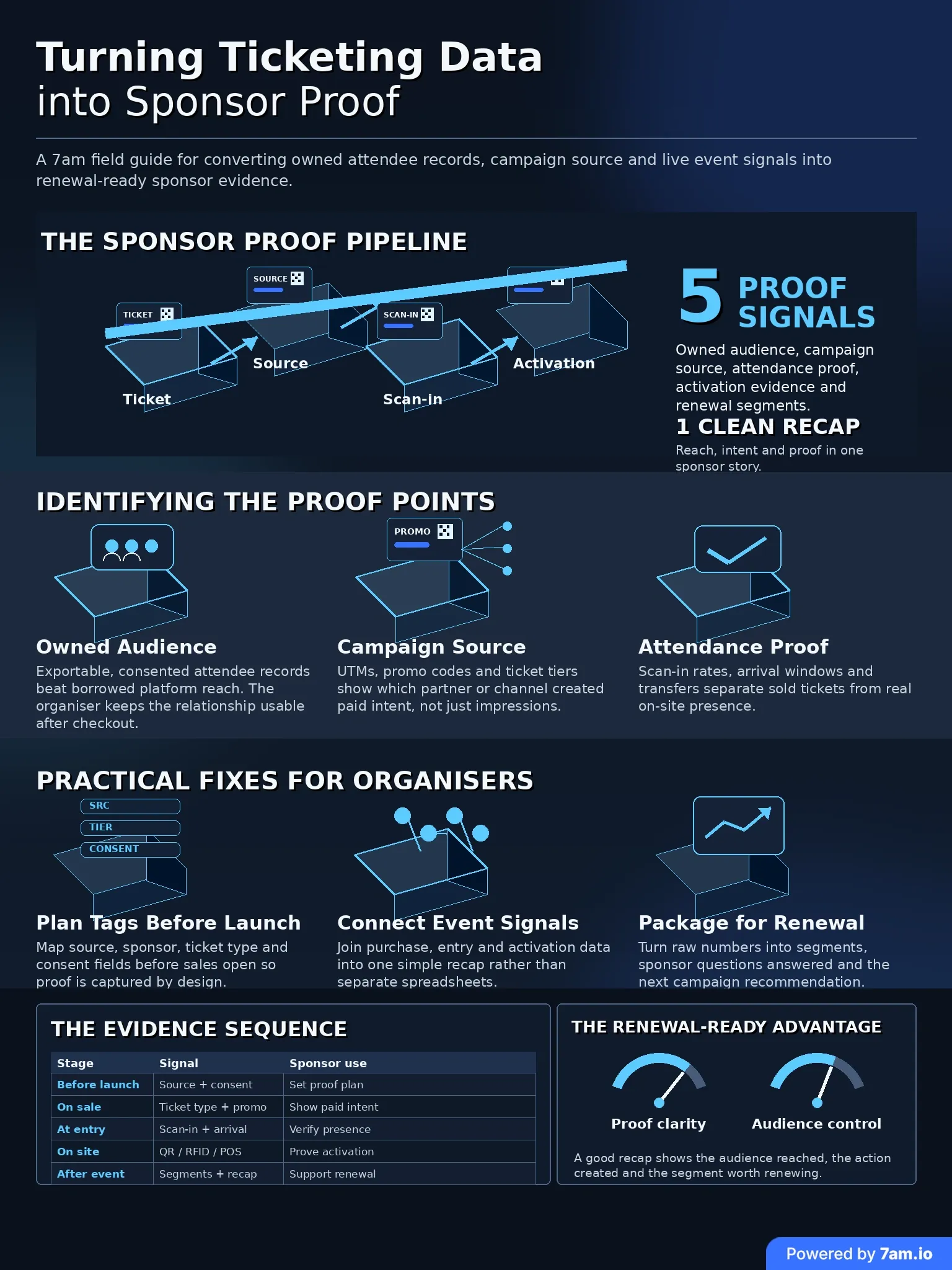
The best time to plan sponsor proof is before tickets go on sale. If the event team waits until the recap deck is due, they are left with whatever the platform happened to capture. A stronger approach is to define the evidence loop early: what must be captured, where it will live, who can access it, and how it will be summarised after the event.
Start with the buyer journey. Each campaign link should be tagged cleanly. Each ticket type should carry a reason, not just a price. Each checkout should preserve source and consent. Each scan-in should connect back to the ticket record. If on-site activations use QR, RFID or app interactions, those signals should be mapped to sponsor questions before the event opens.
A practical sponsor evidence loop looks like this:
1. Define the sponsor claim before launch: reach a niche audience, drive trial, support a community, or create measurable attendance. 2. Map the claim to data fields: source, ticket type, consent, arrival window, engagement and follow-up action. 3. Keep ownership clear: the organiser should be able to access, export and segment the records without begging a vendor. 4. Review weekly during the campaign: watch which sources create paid intent, not only traffic. 5. Build the recap from evidence: one page for outcomes, one for audience quality, one for next action.
That loop also protects the attendee experience. If the data shows mobile buyers dropping out or entry queues forming, the organiser can improve the event instead of merely reporting on it. The same logic applies to optimising ticket purchases for event success: clean measurement is useful only when it changes operations.
A checklist keeps the work practical. The goal is not to collect everything. The goal is to collect the right signals cleanly enough that a sponsor can believe them and the organiser can act on them.
The NotebookLM artifacts used in this article support five checklist areas: contact ownership, performance reliability, data integration, attendance visibility and activation readiness. Each area should have a named owner before the event. Otherwise, data quality becomes everyone's job and no one's responsibility.
Here is the short version:
- Contact ownership: named consent fields, export access, duplicate handling and clear post-event use. - Campaign attribution: tagged links, source fields, promo code logic and weekly conversion review. - Purchase reliability: checkout starts, completions, abandoned checkouts and support issues during peak demand. - Attendance visibility: scan-in rate, arrival times, no-show patterns and transfer behaviour. - Activation reporting: sponsor touchpoints, QR scans, RFID or app interactions where appropriate, and follow-up segments.
7am Tickets should be judged by whether it helps organisers keep the attendee relationship useful. That means clean ticketing operations, practical buyer visibility, and data that supports better launch, reporting and retargeting decisions. The product story is not "more analytics" for its own sake. The useful promise is that organisers can sell tickets and still understand the audience they are building.
For sponsor conversations, that matters because organisers need confidence. They need to know which audiences are responding, where demand is leaking, and what proof they can share with partners. A platform that keeps those signals close to the organiser can support stronger commercial decisions than one that treats the event team as a tenant in its own audience.
This article also sits beside 7am's existing guidance on why attendee data can be worth more than the lineup. The difference here is the sponsor lens. The question is not only who owns the data. It is whether the organiser can turn that ownership into renewal-ready proof.
Sponsor-ready proof starts long before the recap deck. It starts with ticketing data the organiser can access, understand and connect to real attendee behaviour. The NotebookLM research for this run points to the same operational truth from several angles: first-party contacts are more valuable than rented reach, system performance shapes completed demand, and 360-degree data is useful only when the organiser can act on it.
If an organiser wants stronger sponsorship conversations, the next ticketing question should be simple: after this event sells, will we own enough evidence to prove what happened? If the answer is no, the platform is not only processing payments. It is quietly limiting the commercial value of the audience.
Explore More
View All