
More than a third of large-scale festivals globally are now losing money. That is not a bad year. That is a structural collapse.
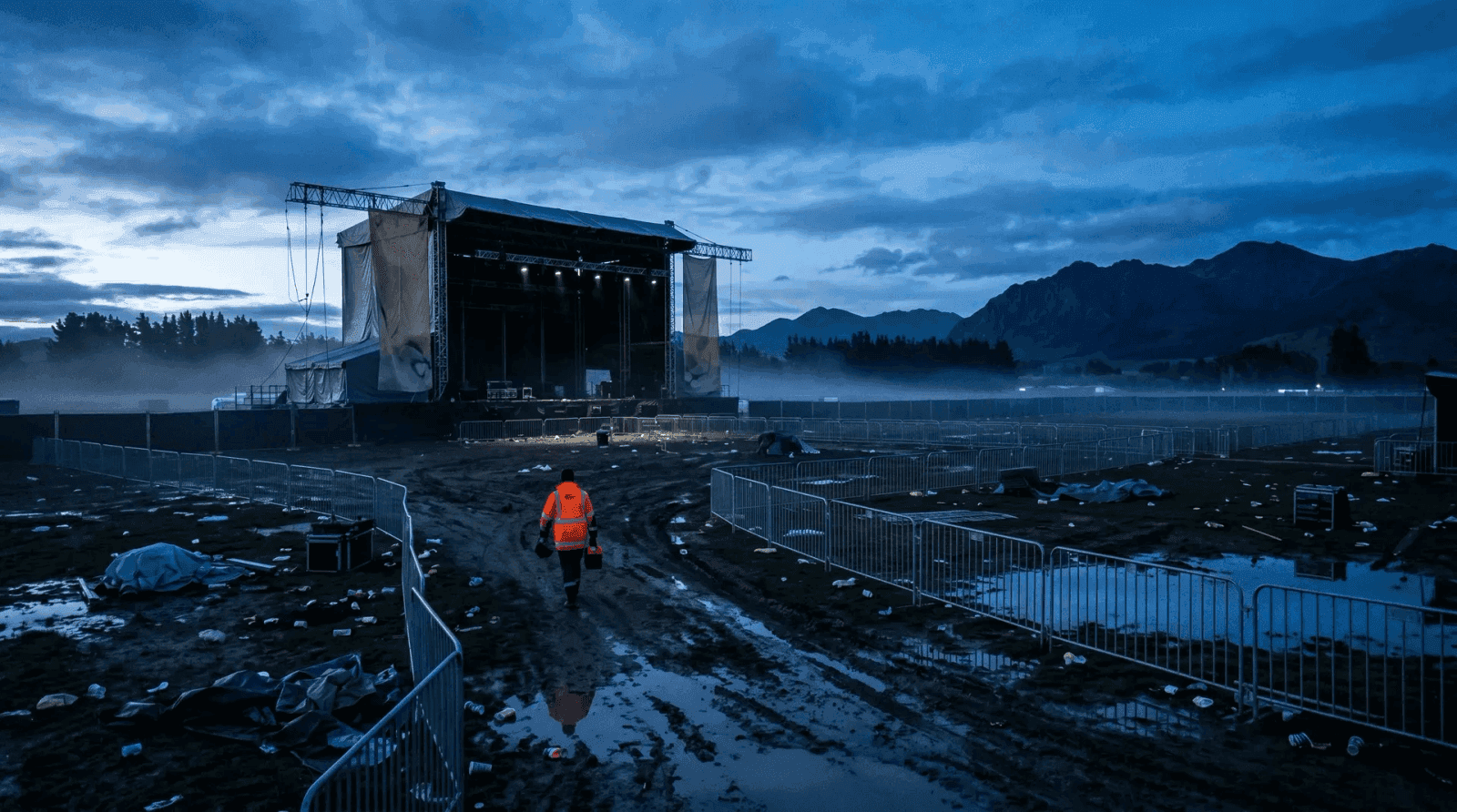
The cancellation list for 2026 reads like a eulogy. Kaslo Jazz Etc. Fest in Canada folded under $250,000 in debt, having not turned a profit since 2019. WOMAD NZ, a fixture of the Taranaki calendar for over two decades, went on hiatus after a 30% spike in post-COVID costs. Splore, one of New Zealand's most beloved boutique festivals, announced its final year after twenty years of operation. One Love, New Zealand's flagship reggae festival, cancelled outright, citing economic challenges. Desert Hearts in the US paused to "reset, refocus, rebuild." AiaSound in Denmark shut down after just five years. We Are One in the UK cancelled before its debut when investors pulled out. Live at Leeds pressed pause for all of 2026.
These are not fringe events run by amateurs. These are established brands with loyal audiences and experienced teams. And they all hit the same wall at roughly the same time.
The pattern tells a clear story. Costs went up. Revenue stayed flat. Margins that were already thin evaporated. The question for every organiser still standing is not whether this affects them. It already does.
Four cost categories exploded simultaneously after 2020, and ticket prices did not keep pace. The gap between what festivals spend and what they earn has become unsustainable for most.
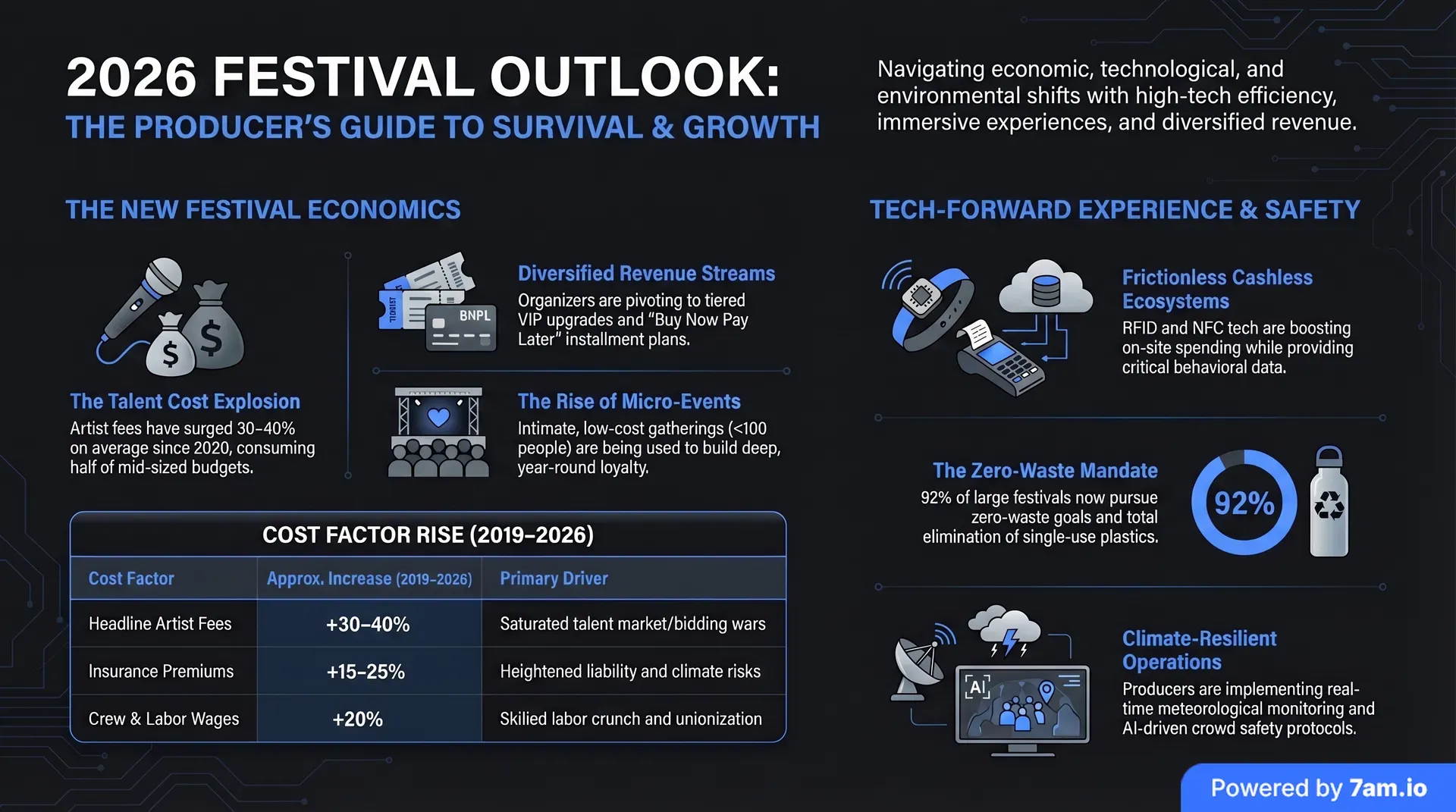
Artist fees climbed 30-40% since 2020. Headliners who commanded $150,000 pre-pandemic now want $200,000 to $210,000. Mid-tier acts followed. The demand for live performance surged post-lockdown, and artists (rightly) repriced their time. But festival budgets were built on 2019 economics.
Insurance premiums jumped 15-25%. Underwriters got burned by COVID cancellations and recalculated the risk profile for outdoor events. Weather events, crowd incidents, public health triggers. Every policy now costs meaningfully more, and some coverage types have simply disappeared from the market.
Production costs rose roughly 40% since 2019. Staging, sound, lighting, barriers, toilets, generators. Every physical component of a festival got more expensive. Supply chains tightened. Lead times stretched.
Crew wages increased 20% thanks to a post-pandemic brain drain. Experienced stage managers, sound engineers, lighting designers, and site managers left the industry during lockdowns. Many never came back. The ones who remained can name their price. Newer crew cost less but bring less experience, which creates its own risks.
Stack those four increases together and a festival that broke even in 2019 is now underwater before it sells a single ticket.
Mega-tours siphon disposable entertainment budgets months before festival season arrives. When a fan spends $300 on a single concert in March, the $200 festival ticket in January starts looking like a hard sell.
Will Page, the former chief economist at Spotify, described it as "cannibalisation." The same industry eating its own market share. Taylor Swift's Eras Tour is the obvious example. It did not just compete with festivals for attention. It competed for wallet share, travel budgets, and annual leave. A group of friends who flew to Melbourne to see Swift in February are not also flying to Taranaki for WOMAD in March.
The dynamic extends beyond any single artist. Global tours by Beyonce, Coldplay, and Bad Bunny all pulled fans into high-priced, high-production stadium experiences that make festival stages feel modest by comparison. Festival organisers are now competing against $500 million production budgets with portable stages and generator power.
For smaller festivals in particular, the impact is brutal. A 3,000-capacity boutique event cannot outspend a stadium tour. It has to outvalue it. And that requires a different kind of proposition entirely, one built on community, setting, and experience rather than headliner wattage.
Organisers are trapped between rising costs and audiences conditioned to resist price increases. Raise tickets too much and attendance drops. Keep them flat and you bleed money.
Ticket prices for mid-size festivals in New Zealand have increased roughly 10-15% since 2019. Costs, as covered above, are up 30-40%. The maths does not work.
The resistance to price increases is partly cultural. Festival audiences have an anchored sense of what a weekend ticket "should" cost. Break that anchor too aggressively and you lose the casual attendees who fill out capacity. Keep it too low and you cannot afford the lineup that attracts them in the first place.
Splore faced exactly this. Twenty years of building a community. Loyal fans who came back every year. But the costs of running the event in Tapapakanga Regional Park kept climbing while the ticket price ceiling stayed roughly the same. Sustainability difficulties. That is the polite way of saying the numbers stopped adding up.
Sponsorship, the traditional pressure valve, has also tightened. Brands are pulling back from live event sponsorship or demanding more measurable ROI. The days of writing a cheque for logo placement on a stage are ending. Sponsors now want data, attribution, and direct audience engagement. Many festivals lack the infrastructure to deliver that level of reporting.
92% of large festivals have now set zero-waste or plastic-free goals. That is progress, but it is also a cost centre that did not exist a decade ago.
Sustainability compliance adds $15,000 to $80,000 to a festival budget depending on size. Compostable serviceware, waste sorting infrastructure, carbon offset programmes, water treatment, noise monitoring. Each regulation or self-imposed standard carries a real cost.
Weather volatility adds risk that is harder to insure against. Flooding, extreme heat, and unexpected storms have cancelled or damaged festivals across the globe. A single weather event can wipe out an entire year's margin. For New Zealand festivals operating on rural or coastal sites, this exposure is increasing.
Consent processes are also getting longer and more expensive. Resource consents, noise management plans, traffic management plans, iwi consultation, ecological assessments. The compliance overhead of running a multi-day outdoor event in New Zealand is materially heavier than it was in 2015. None of this is unreasonable. But it all costs money that has to come from somewhere.
Gen Z is rewriting the rules of live events. They buy later, share differently, and increasingly prefer smaller gatherings over mass-market festivals.
The "soft socialising" trend is real. Younger audiences gravitate toward low-pressure, intimate social settings. A 200-person supper club. A 50-person listening session. A day party rather than a three-day camping odyssey. Micro-events under 100 people are thriving while mega-festivals struggle.
68% of Gen Z say they would pay more for events endorsed by influencers or creators they follow. That stat reshapes how discovery works. Traditional festival marketing (poster, lineup announce, ticket link) reaches a shrinking share of the audience. The path to purchase now runs through TikTok creators, Instagram stories, and group chats.
Late buying is the new normal. Audiences have learned that festivals sometimes discount in the final weeks. Some wait for lineup announcements. Others wait for their friend group to commit. The result is that cash flow, the lifeblood of festival operations, arrives later and less predictably than it used to. Organisers who have mastered pre-lineup selling are in a fundamentally different position than those who have not.
The survivors share three traits: diversified revenue, community-first design, and a willingness to shrink strategically rather than grow into bankruptcy.
Festivals that rely solely on ticket sales and bar revenue are the most exposed. The ones making it work have added camping upgrades, experience packages, VIP tiers, merch collaborations, and year-round community memberships. They have multiple revenue streams feeding the same audience base.
Community-first design means the festival identity does not depend on any single headliner. Attendees buy because of who else will be there, what the site feels like, and what the weekend means to them. When your audience buys for the community rather than the lineup, you gain pricing flexibility and reduce your dependency on expensive headliners.
Shrinking strategically is counterintuitive but effective. A festival that drops from 10,000 to 4,000 capacity can cut production costs dramatically, maintain intimacy, charge more per ticket, and actually make a profit. Growth for growth's sake is what killed many of the events on the cancellation list.
Referral programmes are proving surprisingly powerful. Well-designed fan referral systems boost ticket sales 15-25%, and the cost per acquisition is a fraction of paid advertising. Your existing ticket holders become your sales team. They share links in group chats, tag friends in posts, and build the social proof that drives early sales.
Owning your attendee data matters more than ever. Festivals that control their own ticketing data can run loyalty presales, segment communication, personalise offers, and build direct relationships with their audience. Those relying on third-party platforms for all their ticketing have less control, less data, and less ability to adapt.
Stop building for the audience you had in 2019. Build for the audience that exists today, with today's economics.
Here is what that looks like in practice.
Audit your cost structure against 2024/2025 actuals, not 2019 benchmarks. If your budget still assumes pre-pandemic pricing for artist fees, insurance, or crew, it is wrong. Reprice every line item.
Build a profitability framework before you announce anything. Know your break-even ticket count. Know your margin at 60%, 80%, and 100% capacity. If the event is not profitable at 70% capacity, redesign it until it is.
Sell tickets before the lineup. The festivals that survive the next three years will be the ones whose audiences buy on trust, not on headliners. That requires year-round community engagement, tiered pricing architecture, and a brand that means something beyond "good lineup." If you are not already doing this, start with blind-bird and early-bird tiers.
Diversify revenue per attendee. Camping packages, experience add-ons, merch drops, food partnerships, VIP upgrades. Every dollar of non-ticket revenue reduces your dependency on raw capacity.
Stop avoiding ticketing mistakes that compound the financial pressure. Pricing errors, poor tier structure, and broken checkout flows leak revenue that festivals cannot afford to lose.
Own your data. Use a ticketing platform that gives you full access to buyer data, purchase behaviour, and marketing attribution. Build a direct relationship with every person who buys a ticket.
The dynamic pricing backlash is making this worse, not better.
And with 57% of tickets now selling in the final week, cash flow pressure on festivals has never been higher.
Festivals are not dying because people stopped wanting to gather. They are dying because the business model that sustained them for two decades broke, and too many organisers are still pretending it did not.
The cost base shifted permanently. Audience behaviour evolved. Competition from mega-tours intensified. The festivals that acknowledge this reality and restructure accordingly will survive. The ones waiting for costs to come back down, or for audiences to behave like they did in 2018, will join the cancellation list.
The blueprint is visible. Smaller, tighter, community-driven. Multiple revenue streams. Pre-lineup sales. Owned data. Strategic pricing. The tools exist. The question is whether organisers are willing to use them before the money runs out.
Start with 7am and build the ticketing infrastructure that gives you control over pricing, data, and direct fan relationships from day one.
Explore More
View All